
Quick Answer
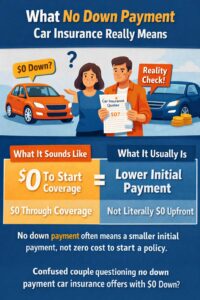
No down payment car insurance usually does not mean zero dollars due at signup. In most cases, it refers to a lower upfront payment or a monthly billing structure. Before starting coverage, always confirm how much is due today.[1]
If an offer makes it sound like you can start car insurance today without paying anything upfront, it is easy to see why that sounds appealing. In practice, most insurers still require some payment before coverage begins.
What many drivers call no down payment car insurance is usually a policy with a lower upfront cost, not a true zero-cost start.[1] That is why it helps to look past the headline wording and focus on the actual amount due before the policy becomes active.
What “No Down Payment” Really Means
What You Usually Pay Upfront
- First month of coverage or the first scheduled premium payment
- An initial installment of the total premium
- Optional coverages such as collision or comprehensive, if selected
- Required liability or other state-mandated coverages included in the policy
- Possible monthly billing, installment, or processing fees
The exact amount depends on your location, driving history, vehicle, coverage choices, and insurer. Two drivers can see very different upfront costs on the same day.[1][4]
How to Get Covered Faster
- Driver’s license information
- Vehicle VIN
- Address and garaging location
- Previous insurance details
- Payment method ready
Same-day insurance is possible, but you will almost always need to complete payment before the policy becomes active.[1] Drivers who need proof of coverage fast can also review how same day car insurance usually works before starting the application process.
How to Lower Your Upfront Cost
- Compare multiple insurers
- Choose monthly billing when the total cost still makes sense
- Adjust coverage levels carefully
- Ask about discounts
- Avoid lapses in coverage
- Review deductible options realistically
The goal is not zero cost, but a manageable first payment and a monthly premium you can sustain. Comparing the same coverages across multiple insurers is one of the best ways to find a better structure.[2][5] If your main priority is paying as little as possible to start, it is also worth comparing cheapest car insurance with low down payment options to see how pricing and billing structures can vary.
Why Insurers Usually Require an Upfront Payment
Many drivers assume the first payment is just a sales tactic, but there is a practical reason it exists. Car insurance starts providing financial protection as soon as the policy becomes active, so the insurer begins taking on risk immediately.
Because coverage can begin right away, most insurance companies require an initial payment before they issue the policy. In many cases, that payment is simply the first part of the premium rather than some separate “deposit” sitting on top of it. This is one reason “no down payment” can be misleading if you read it too literally. The policy may still start with a lower first bill, but it rarely starts with nothing due at all.[1]
For drivers shopping on a tight budget, this distinction matters. A company advertising a low upfront cost may still be a reasonable option, but only if the total policy cost, payment schedule, and coverage details make sense once you look past the headline. If you want a broader comparison of low or no down payment car insurance options, it helps to look beyond the marketing language and focus on the actual amount due before coverage begins.
What Can Make Your First Payment Higher or Lower?
The first amount due is affected by more than the insurer’s brand name. It also depends on how the company prices your risk and how the policy is structured. That is why one driver may qualify for a manageable first payment while another gets quoted a much larger amount for similar coverage.
- ZIP code: Rates often change by area because accident frequency, theft, repair costs, and other location-based factors vary.
- Driving record: Tickets, accidents, or serious violations can increase both the total premium and the amount due upfront.
- Vehicle type: Repair costs, theft risk, safety record, and vehicle value can affect pricing.
- Coverage level: Liability-only coverage is usually cheaper to start than adding collision and comprehensive.
- Lapse in prior insurance: A gap in coverage can raise the cost of starting a new policy.
- Payment plan: Paying monthly may lower the starting amount, while paying more upfront can sometimes lower total cost.
This is why comparing quotes matters so much. A driver who checks only one insurer may assume the upfront payment is fixed, when in reality another company may offer a better structure for the same general need.[2][4]
Low Upfront Cost Does Not Always Mean Low Total Cost
One of the most common mistakes drivers make is focusing only on the first payment. A smaller amount due today can feel like the best deal, but that does not automatically make it the cheapest policy overall.
Some plans reduce the upfront cost by spreading more of the premium into later monthly installments. That can be useful when cash is tight, but it may also mean you pay more over time through extra fees, higher monthly bills, or a less favorable billing structure. In other words, a policy that is easier to start is not always the least expensive to keep.[1][2]
That is why it helps to compare both:
- the amount due today, and
- the total cost over the policy term.
A balanced decision usually works better than chasing the absolute lowest starting price. The right policy is one you can activate now and realistically maintain over the next several months.
How to Shop Smarter When Budget Is Tight
If you need insurance quickly and you are trying to keep the first payment low, the goal should be to shop carefully rather than rush into the first offer that sounds easy. A smarter approach can help you avoid misleading promotions and improve the odds of finding a workable policy.
- Check more than one quote source. Prices and payment structures vary, so one insurer may offer a more manageable start than another.[2]
- Know what coverage you actually need. If your budget is very limited, start by understanding whether liability-only coverage is legally sufficient for your situation.[1]
- Review the effective date. Make sure you know exactly when the policy starts and whether it becomes active immediately after payment.[1]
- Ask about fees. Monthly billing and installment charges can affect the real cost.[1][2]
- Confirm the insurer or agency name. Make sure the company is licensed and check complaint information when possible.[2][3]
These simple checks can help you avoid buying coverage that looks cheap at first but turns into a worse financial decision later.
When a Lower First Payment Makes Sense
A lower first payment can be a smart option when you need legal coverage immediately, you are trying to avoid a lapse, or you simply need more flexibility in how you handle your monthly expenses. For many drivers, the better solution is not waiting for a mythical zero-down offer. It is finding a policy that starts at a manageable cost and keeps them insured without creating a bigger payment problem next month.
That is especially true for drivers who have just bought a vehicle, need proof of insurance quickly, are changing insurers, or need to restore coverage after a recent lapse. In those situations, a realistic low upfront payment is often more useful than chasing a phrase that sounds better than it works in practice.
As long as you understand the billing structure, confirm the coverage terms, and choose a reputable provider, a low-down-payment option can be a practical way to get insured without overextending yourself on day one.
Warning Signs
- “Zero payment” promises with no conditions
- Prices that change at checkout
- No clear coverage start date
- Missing insurer details
- Pressure to buy quickly
For more related insurance topics and budget-focused coverage guides, you can also browse the blog.
Frequently Asked Questions
Can you really get car insurance with no down payment?
Usually not. Most insurers require at least some payment before coverage starts, even if the first amount due is lower than normal.[1]
Is same-day insurance possible?
Yes, but payment and policy setup still usually need to be completed before activation.[1]
What is the best alternative?
For most drivers, the more realistic alternative is low down payment insurance, monthly billing, or affordable liability-only coverage rather than expecting true zero-upfront coverage.
How can I lower my first payment?
Compare quotes, review coverage limits, ask about discounts, and look at deductible and payment-plan options carefully.[2][5]
References
- [1] National Association of Insurance Commissioners (NAIC): A Consumer’s Guide to Auto Insurance
- [2] Insurance Information Institute (III): How to Find the Right Auto Insurance
- [3] NAIC Consumer Insurance Search
- [4] Insurance Information Institute (III): What Determines the Price of an Auto Insurance Policy?
- [5] Insurance Information Institute (III): Understanding Your Insurance Deductibles