
If you need car insurance soon but want to avoid a large upfront payment, you are not the only one. Many drivers look for low or no down payment car insurance because they want to start coverage without putting too much strain on their budget on day one.
In practice, most insurers still require some payment before a policy becomes active. The real goal is usually not finding a true zero-cost start, but finding a lower upfront payment and a billing structure that you can realistically manage.[1]
Quick Answer
Low or no down payment car insurance usually means a smaller amount due upfront, not truly free coverage at signup. In most cases, coverage starts only after the first required payment is made. What matters most is the actual amount due today, the monthly payment structure, and the total cost over the policy term.[1]
That is why it helps to look past the wording of the offer and focus on how the policy is actually structured. A lower first payment can be useful, but it should still come from a policy that fits your coverage needs and remains affordable after the first bill.
Before choosing a policy, compare the amount due today, the monthly payment amount, the coverage included, and any fees tied to the billing plan. That gives you a much clearer picture than the phrase “no down payment” by itself.[2]
Can You Really Get Car Insurance With No Down Payment?
Most insurers do not offer true zero-down policies. Instead, what you usually see is a lower first payment, a monthly billing plan, or another payment structure that reduces the amount due at the beginning.[1]
In many cases, the offer looks like this:
- A smaller first payment
- A monthly billing plan instead of a large upfront cost
- A policy that activates after your first payment[1]
The key is to focus on affordability and speed, not just the wording of the offer. Many policies marketed this way are simply lower-upfront-payment policies rather than true zero-cost starts.
What You Need to Get Started
- Driver’s license
- Vehicle VIN
- Address and ZIP code
- Driving history
- Payment method
Having this information ready can help you move through the quoting and purchase process faster, sometimes within minutes.
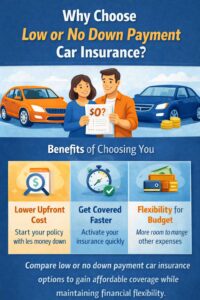
Why Down Payments Exist in Car Insurance
Understanding why insurers require an upfront payment can help you make better decisions when comparing policies. Car insurance begins providing financial protection as soon as it becomes active, so insurers typically require an initial payment before issuing coverage.[1]
In many cases, that first payment is simply part of the premium rather than some separate extra charge. That is why even flexible billing plans usually still require money upfront before coverage starts.[1]
That is also why “no down payment” can be misleading if read too literally. A lower first bill can still be useful, but it rarely means that nothing is due at all.
What Affects Your Initial Payment Amount
The upfront cost you see when applying for car insurance is not random. It is influenced by several pricing factors that insurers use to estimate risk and premium level.[4]
- Your driving history: Accidents, tickets, or serious violations can increase your initial cost
- Your location: Rates often vary by area because claim frequency, theft, repair costs, and traffic conditions differ
- Your vehicle: Repair costs, theft risk, value, and safety record can all affect pricing
- Your credit profile (in some states): It can influence pricing and payment structure
- Coverage level: Full coverage usually costs more to start than liability-only coverage
- Insurance history: Gaps or lapses can increase the first payment
Because of these variables, two drivers searching for the same general type of coverage can see very different upfront costs.[4]
Common Misunderstandings About “No Down Payment”
Many drivers misunderstand what “no down payment” actually means because of how it is advertised online. While the phrase is widely used, it rarely reflects how policies are structured in practice.
Some of the most common misconceptions are:
- “I will not pay anything today” — In most cases, some payment is still required[1]
- “It is a rare special deal” — Many insurers simply offer similar billing structures
- “It is cheaper overall” — A lower upfront cost does not always mean a lower total premium[1]
- “Coverage starts instantly without payment” — Activation usually requires payment confirmation[1]
Understanding these differences helps you focus on realistic options instead of marketing language alone.
Smart Ways to Compare Quotes
When searching for low or no down payment car insurance, comparing quotes the right way can make a major difference in what you pay upfront and over time.
Instead of looking only at the first payment, compare the full picture:
- The total premium over the policy term
- The size of the initial payment
- The monthly payment amount
- Any fees included in the billing plan
- The level of coverage provided
Some policies may look cheaper at the beginning but cost more over time. Others may require slightly more upfront but offer better long-term value. That is why it is generally smart to compare quotes from multiple insurers and compare like-for-like coverage before deciding.[2]
If your focus is mainly price, it is worth reviewing cheap car insurance with a low down payment so you can compare affordability more directly.
Quick Steps to Get Covered Today
Liability vs Full Coverage: What Changes Upfront
The type of coverage you choose has a major impact on your upfront cost.
Liability-only coverage is usually the lowest-cost way to start a policy because it covers damage or injuries you cause to others, but not damage to your own vehicle. Most states require at least some level of liability coverage to drive legally.[5]
Full coverage usually includes liability plus optional coverages such as collision and comprehensive. Those added protections often raise the amount due upfront because they increase the total premium.[5]
If your goal is to minimize the amount due today, many drivers start with liability coverage and then reassess later if their budget improves.
How Payment Plans Impact Your First Bill
Insurance companies often offer different billing options, and each one affects how much you pay upfront.
- Paid in full: Often the lowest total cost, but the highest upfront payment
- Monthly billing: Lower upfront amount, but it may increase total cost over time if fees apply[1]
- Installment plans: A middle ground between upfront and monthly payments
Choosing the right payment structure depends on your current financial situation. If you need coverage immediately but have limited funds, monthly billing can be practical, but it is still worth checking whether it comes with extra charges.[1]
Why Choosing a Reputable Insurer Matters
When comparing lower-upfront-cost policies, it is worth checking that the insurer is licensed and easy to verify. Reliable companies provide clear pricing, proper documentation, and policies that comply with state regulations.
Working with unknown or unverified providers can lead to problems such as:
- Invalid or incomplete coverage
- Unexpected fees or cancellations
- Difficulty filing claims
- Lack of customer support
It is smart to verify that an insurer is licensed and to check complaint information through official consumer tools before buying a policy.[2][3]
How to Lower Your Down Payment
1. Choose Liability Coverage
Minimum required liability coverage is often the cheapest way to start a policy and may require a lower upfront payment than broader coverage.[5]
2. Select Monthly Billing
Instead of paying a large portion upfront, many insurers let you split payments monthly, though you should still review whether that increases the total cost.[1]
3. Compare Multiple Quotes
Prices vary significantly between insurers. Comparing multiple options is one of the fastest ways to find a lower initial cost.[2]
4. Avoid Coverage Lapses
If you have had a gap in insurance, your upfront cost may be higher. Staying continuously insured can help you avoid some pricing penalties tied to prior insurance history.
Can You Get Same-Day Coverage?
Yes. Many insurers offer same-day coverage, but it usually still requires:
- Completing your application
- Providing accurate information
- Making your first payment[1]
If you are in a hurry, this is often the fastest path to getting insured legally. You can also review our page on same-day car insurance to better understand how fast activation usually works.
What to Avoid
- Offers promising “$0 today” with no conditions
- Unclear coverage start dates
- Hidden fees at checkout
- Unknown or unlicensed providers
Final Takeaway
You may not find true no-down-payment insurance, but you can absolutely find low upfront cost coverage that works for your situation.
The best approach is to compare options, understand the payment structure, and choose a policy you can maintain over time. For more related guides, you can also browse the car insurance blog.
Frequently Asked Questions
Can I get insured today?
Yes, many insurers offer same-day coverage once you complete your application and payment.[1]
What is the cheapest way to start?
Choosing liability-only coverage and a monthly plan is often one of the lowest-upfront options, but you should still compare the total cost and fees.[1][5]
Do all insurers require payment upfront?
Most reputable insurers require at least some payment before coverage begins.[1]
References
- [1] NAIC: Consumer Shopping Tool for Auto Insurance
- [2] Insurance Information Institute: How to Find the Right Auto Insurance
- [3] NAIC Consumer Insurance Search
- [4] Insurance Information Institute: What Determines the Price of an Auto Insurance Policy?
- [5] Insurance Information Institute: What Is Covered by a Basic Auto Insurance Policy?