
If you are trying to find the best low down payment car insurance companies, the hard part is that “best” does not mean the same thing for every driver. For one person, the best option may be the company with the lowest amount due today. For someone else, it may be the insurer with clearer billing terms, better claims support, or a payment plan that is easier to keep up with over time.
That is why the smartest way to compare these companies is not to chase the smallest first bill alone. A low upfront payment can help you get covered now, but the better choice is usually the insurer that combines a manageable first payment, understandable billing terms, and coverage you can realistically maintain month after month.[1]
Quick Answer
The best low down payment car insurance companies are not always the ones with the smallest first bill. The better choice is usually the insurer that combines a manageable upfront payment, clear billing terms, reliable service, and coverage you can actually maintain over time.
What “Best” Really Means for Low Down Payment Insurance
There is no single best company for every driver. Different insurance companies can charge different rates for the same coverage, and they may not provide the same level of service after you buy.[1] That is why the best option is usually the company that gives you a reasonable first payment, a payment plan you can afford, and terms you understand before you commit.
This matters even more if you need same-day car insurance, where speed can tempt drivers to focus only on the amount due now and ignore the rest of the policy.
What the Best Companies Usually Have in Common
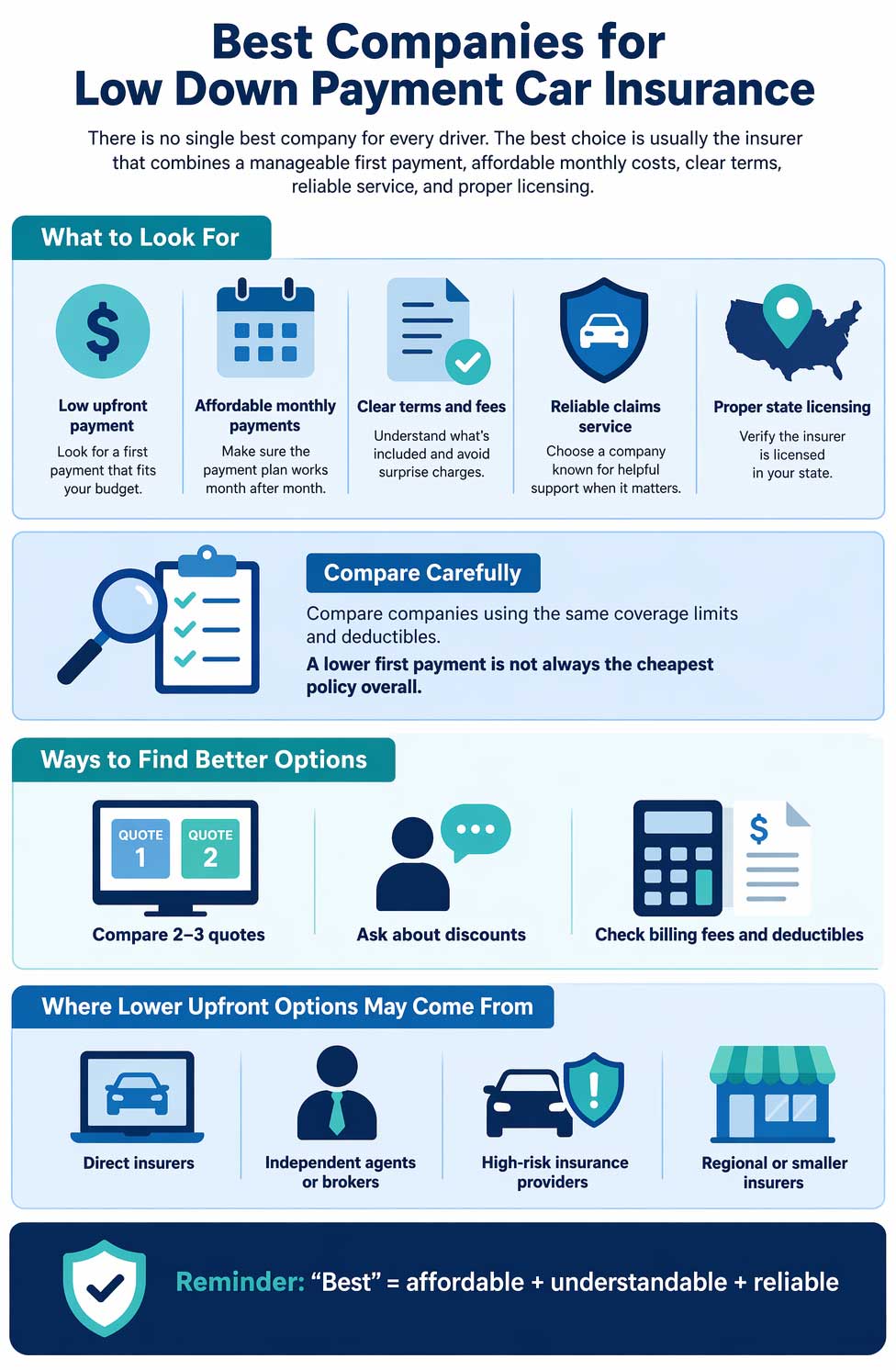
The strongest low down payment options usually share a few practical qualities. Instead of focusing only on marketing claims, it helps to look for companies that offer the following:
- Low upfront payment options
- Clear monthly billing terms
- Fast policy activation
- Transparent fees and deductibles
- Reliable claims handling
- Proper state licensing
When you compare quotes, try to match the same coverage limits and deductibles each time. Consumer guidance also recommends shopping around and comparing multiple insurers instead of assuming the first option is automatically the best.[1][2]
Types of Companies That May Offer Lower Upfront Costs
In many cases, “best” does not mean one specific brand. It means finding the type of insurer that fits your driver profile, budget, and urgency. Different types of companies may structure the first payment differently, even when the policy itself looks similar on the surface.
Direct Insurers
Direct insurers sell policies online, by phone, or through their own agents. They may be a strong fit if you want faster quotes and a simpler purchase process.
Independent Agents and Brokers
Independent agents can compare several insurers and may help you spot differences in billing structure, fees, or coverage that are easy to miss when you shop alone.[2]
High-Risk Insurance Providers
Some insurers are more open to drivers with tickets, accidents, or prior gaps in coverage. They may offer a lower first payment, but the total premium can still be higher over time.
Regional or Smaller Insurers
Regional carriers can sometimes be more flexible with payment structure for specific states or driver profiles. They should still be checked carefully for licensing and complaint history before you buy.[2][3]
How to Choose the Right Company
Choosing the right insurer is not just about the lowest number you see today. It is about getting coverage that makes sense now and stays affordable in the months ahead.
- Compare at least 2 or 3 quotes
- Match the same coverage limits when comparing prices
- Review deductibles carefully
- Ask whether monthly billing includes extra fees
- Confirm the company is licensed in your state
- Check complaint information through official resources
If your priority is mostly saving money, it also helps to compare cheap car insurance with a low down payment before choosing a provider.
You can confirm whether an insurer is licensed through your state insurance department or through NAIC consumer tools. NAIC guidance also encourages drivers to check complaint information where possible before buying a policy.[2][3]
How Low Down Payment Billing Really Works
Insurance companies do not set your initial payment randomly. The amount due at the start of the policy depends on how the premium is billed, how much risk the insurer sees, the coverages you choose, and whether the company allows installment payments.
In practice, many policies fall into one of these patterns:
- Higher upfront / lower monthly: More paid at the beginning, with smaller installments later
- Balanced payments: A more even split between the first payment and the rest
- Lower upfront / higher monthly: A smaller first payment, sometimes with installment fees or a higher total cost over time
NAIC consumer guidance notes that many insurers let drivers pay monthly, but monthly billing can involve an extra fee.[2] That is why the lowest first payment is not always the cheapest policy overall. Before choosing an offer, it can also help to review what no down payment car insurance really means in real-world billing terms.
Are Smaller Insurance Companies Better for Low Down Payments?
Sometimes they can be. Smaller or regional insurers may be more flexible with certain driver profiles or payment arrangements. But smaller does not automatically mean better.
What matters more is whether the company is:
- Licensed in your state
- Clear about coverage and billing terms
- Reasonably responsive during claims
- Transparent about fees and payment structure
Consumer guidance recommends checking whether an insurer is licensed and reviewing complaint information where available.[2][3]
Direct Insurer vs. Broker: Which Is Better?
When looking for low down payment car insurance, you will usually see two common paths: buying directly from the insurer or working with a broker or independent agent.
Buying Direct
This approach may be faster if you already know what coverage you need and want a quick online quote. It can also make it easier to bind coverage the same day.
Working With a Broker or Independent Agent
This can be more useful if your profile is more complicated, you have had prior lapses, or you want help comparing several companies at once. Independent agents can often present multiple quotes instead of just one insurer’s offer.[2]
For many drivers, the smartest move is using both: gather direct quotes online, then compare them against at least one broker or independent-agent quote before you choose.
How Companies Handle Higher-Risk Drivers
If you have accidents, tickets, a lapse in coverage, or poor prior insurance history, your quote options may look very different from those of a lower-risk driver. Some insurers specialize in higher-risk drivers and may be more flexible with the first payment, but they may still charge more overall.
That kind of policy may still make sense if you need coverage immediately. The key is not to confuse a lower first payment with a lower long-term cost.
When It Makes Sense to Switch Insurance Companies
Many drivers stay with the same insurer out of habit. But switching companies can sometimes reduce both the first payment and the monthly cost, especially if your driving record has improved or your current policy has become more expensive.
You may want to compare new options if:
- Your premium has increased sharply at renewal
- You found a better payment structure elsewhere
- Your driving record has improved
- You need a lower upfront cost without cutting essential coverage too far
Always make sure the new policy is active before canceling the old one.
Tips to Get the Best Deal From Any Company
No matter which insurer you choose, a few practical steps can improve your odds of finding a better balance between upfront cost and long-term value.
- Compare multiple insurers: Rates can differ significantly for the same coverage.[1][2]
- Ask about discounts: Consumer guidance recommends asking about discounts when getting quotes.[2]
- Review deductibles: A higher deductible can lower your premium, but only choose one you could realistically afford after a claim.[4]
- Check for billing fees: A low first payment may come with installment charges.[2]
- Avoid a coverage lapse: Gaps in coverage can make future insurance more expensive.[2]
These strategies are often more useful than chasing the first advertised “$0 down” promise you see.
What to Watch Out For
- Companies promising “$0 upfront” with no clear explanation of billing terms
- Quotes that look cheap only because they use weaker coverage limits
- Policies with unclear installment fees or poorly explained deductibles
- Unlicensed sellers or offers that pressure you to buy immediately
Why Comparing Companies Matters
No single company is always the cheapest or the best for every driver. Pricing changes based on your profile, location, vehicle, prior insurance history, and the coverage choices you make.[1][2]
That is why comparing options is usually the most effective way to reduce both your upfront payment and your total cost. If you want a more practical starting point, you can also review our guide on low or no down payment car insurance.
Final Takeaway
The best low down payment car insurance companies are the ones that give you a payment structure you can realistically keep, not just the lowest number on the first screen. A smart choice balances upfront affordability, monthly cost, clear terms, and dependable service.
For more budget-focused coverage guides and related topics, you can explore the car insurance blog.
Frequently Asked Questions
Which company has the lowest down payment?
There is no single answer for every driver. The lowest upfront option depends on your state, driving history, vehicle, and coverage choices.
Does a lower down payment mean cheaper insurance overall?
No. Some policies with a smaller first payment can cost more over time if they use installment fees or higher ongoing payments.[2]
How can I check if an insurance company is legitimate?
Start by verifying that the insurer is licensed in your state and reviewing complaint information through official insurance department or NAIC resources.[2][3]
Are brokers better than buying direct?
Not always. Buying direct can be faster, while a broker or independent agent can be better for comparing several insurers at once. Many drivers benefit from doing both before choosing.
Should I switch companies to lower my upfront cost?
It can be worth comparing. Just make sure the new policy is fully active before canceling the current one.