
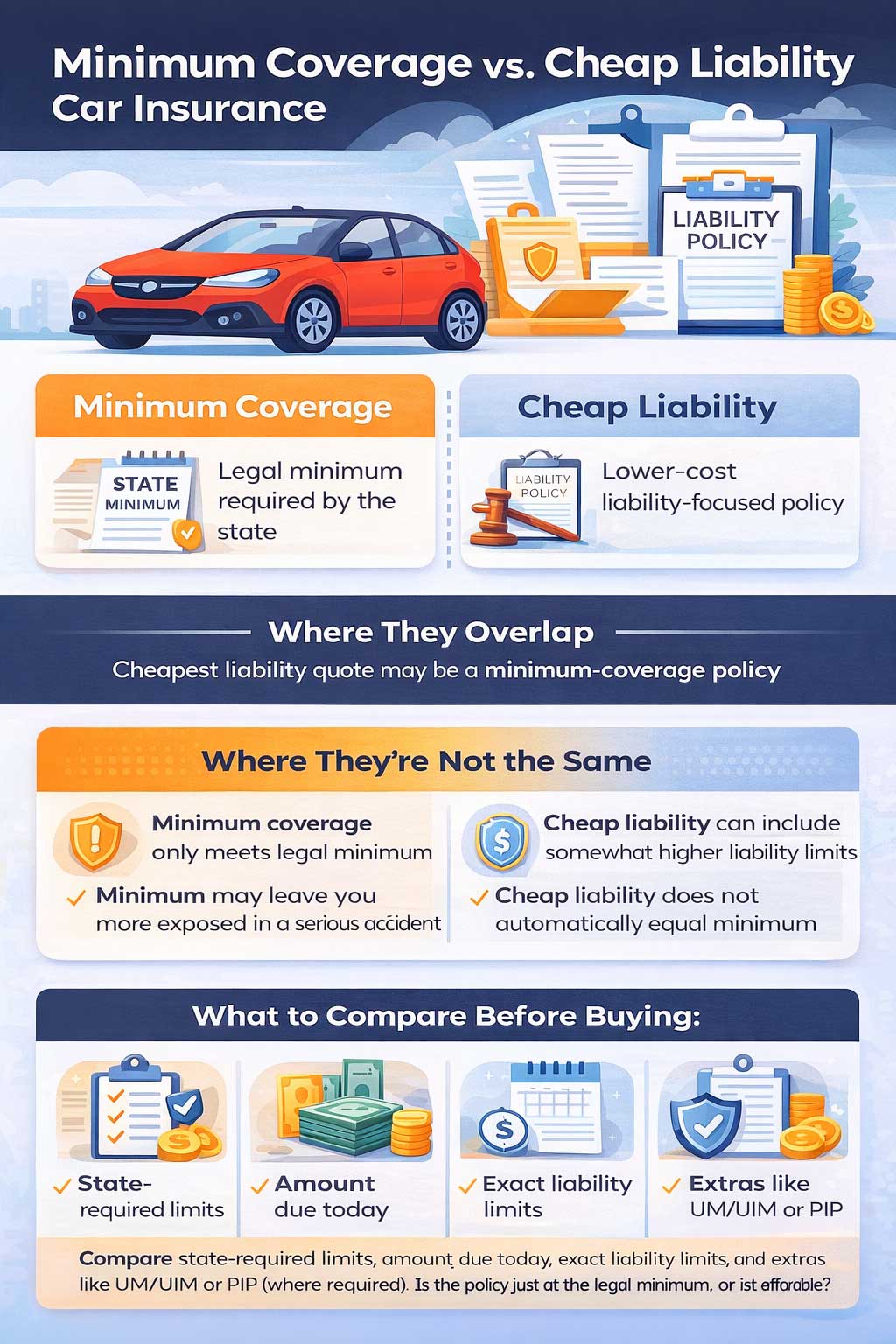
Many drivers assume that minimum coverage and cheap liability car insurance mean the same thing. They often overlap, but they are not identical. Minimum coverage usually refers to the least amount of insurance your state requires for legal driving. Cheap liability car insurance is a broader shopping idea focused on finding lower-cost liability protection, which may match the state minimum or may include higher limits, required add-ons, or a different billing structure altogether. [1][2][3]
That distinction matters because a policy can be cheap without being only the bare legal minimum, and a minimum-coverage policy is not always the cheapest practical option once you compare limits, deductibles, fees, and the risk of paying out of pocket after a crash.
Quick Answer
Minimum coverage usually means the lowest insurance your state requires. Cheap liability car insurance usually means a lower-cost liability-focused policy, but that policy may still carry more protection than the legal minimum. The two ideas overlap, but they are not automatic matches. The safer way to compare them is to look at the exact liability limits, any state-required extras such as UM/UIM or PIP where applicable, the amount due today, and what losses would still be your responsibility after an accident. [4][5]
Important: State minimum requirements, required add-on coverages, and insurer pricing can vary significantly by state and driver profile. A policy that qualifies as minimum coverage in one state may not look the same in another. [6][10]
What Minimum Coverage Usually Means
Minimum coverage is mainly a legal concept. In most states, drivers must carry at least a minimum amount of auto insurance or other financial responsibility before driving legally. In many states, that minimum includes bodily injury liability and property damage liability. Depending on the state, it may also involve other coverages such as uninsured or underinsured motorist protection or personal injury protection. [1][4][6]
So when someone says “I just need minimum coverage,” what they often mean is: “I want the smallest legally acceptable policy.” That is different from saying they want the cheapest quote available regardless of whether it sits exactly at the legal floor or slightly above it.
What Cheap Liability Car Insurance Usually Means
Cheap liability car insurance is a shopping term, not a legal one. It usually refers to a policy built around liability coverage rather than broader protection for your own vehicle. A cheap liability policy may track the state minimum, but it can also include somewhat higher liability limits while still remaining one of the lower-cost options in the market. [2][3]
That is why the word “cheap” should be read carefully. It can mean lower premium, lower upfront payment, or fewer optional coverages. It does not automatically tell you whether the policy only meets minimum legal requirements or whether it offers somewhat stronger liability protection at a still-affordable price.
| Term | Main Meaning | What to Check |
|---|---|---|
| Minimum coverage | The least coverage your state allows for legal driving | Exact required limits and any mandatory add-ons in your state |
| Cheap liability car insurance | A lower-cost policy centered on liability protection | Whether the low price comes from low limits, fewer extras, or both |
| Liability-only policy | Coverage mainly for damage or injuries you cause to others | What is not covered for your own vehicle or your own losses |
Where the Two Ideas Overlap
The overlap is simple: the cheapest liability quote in your market may in fact be a minimum-coverage policy. That is common. A driver looking only for legal compliance, especially on an older vehicle, may end up comparing policies that sit very close to the state minimum requirements.
That is why the two terms get mixed together so often. In many real searches, the shopper is not using legal language precisely. They are really saying, “I want the least expensive way to stay insured.” Sometimes that ends in a true minimum-coverage policy. Sometimes it ends in a slightly stronger liability policy that still fits the budget better overall.
Where They Stop Meaning the Same Thing
The difference shows up when a cheap liability policy includes more than the bare minimum. A carrier may price a somewhat higher liability limit competitively enough that it still feels cheap compared with other quotes. On the other hand, a true minimum-coverage policy may look cheapest at checkout but leave you much more exposed if you cause a serious accident and losses exceed your policy limits. The NAIC’s consumer guide notes that state minimum liability requirements may be too low to fully protect you in a serious crash. [5]
This is the practical issue: cheap is about price, while minimum is about legal sufficiency. Those are related ideas, but they are not identical. A quote can be affordable without sitting exactly at the legal floor, and the legal floor is not always the strongest financial choice.
What Liability Coverage Usually Pays For
Liability coverage is meant to protect you when you are responsible for injury or damage to other people. Bodily injury liability generally addresses injuries or deaths you cause, while property damage liability generally addresses damage to another person’s vehicle or other property. The III notes that these protections can also include legal defense expenses when you are sued over covered damage. [2][3]
What liability coverage usually does not do is pay to repair your own car after a crash you caused. That is one of the most important consumer distinctions in this whole topic. A driver can buy the cheapest liability policy available and still face a large out-of-pocket repair bill for their own vehicle if that policy does not include collision or other physical damage coverage. [2][7]
Why Minimum Coverage Can Still Be Risky
The problem with minimum coverage is not that it is illegal or automatically bad. The problem is that legal minimums are designed as a floor, not as a guarantee that you will be financially protected after a serious loss. If damages exceed your liability limits, you may be personally responsible for the difference. The NAIC and III both warn, in different ways, that minimum required amounts may be too low for major accidents. [5][8]
That means a very cheap minimum-coverage policy can be reasonable for some drivers as a temporary or tightly budgeted solution, but it should not be mistaken for a policy that necessarily provides enough protection for every financial situation.
Simple Rule of Thumb
If a quote is described as cheap liability, do not assume it is identical to your state minimum. Check the actual bodily injury and property damage limits, confirm any required state extras, and ask what losses would still be yours to pay after an at-fault accident. [5][9]
When Minimum Coverage May Make Practical Sense
A minimum-coverage or near-minimum liability policy can make practical sense when a driver is mainly trying to stay legally insured, keep the vehicle on the road, and manage a tight budget. This comes up often with older cars, lower-value vehicles, or drivers who are prioritizing immediate affordability over broader protection.
Even then, the decision should be deliberate. If your budget is driving the choice, it is smarter to compare amount due today, liability limits, required extras, and billing structure together rather than focusing only on the lowest monthly number. Our no down payment car insurance total cost guide can help with that side of the math.
When Cheap Liability Does Not Mean Bare Minimum
Sometimes the best cheap liability option is not the strict state minimum. A quote can remain affordable while offering somewhat stronger protection than the legal floor. This can happen when a carrier prices higher liability limits competitively, or when differences in underwriting and rating make a better-protected quote only modestly more expensive than the bare minimum. [1][5]
That is why shoppers should compare the actual policy structure, not just the label. A policy that is slightly more expensive but materially stronger can still be the better value.
How to Compare the Two Without Confusing Yourself
The NAIC recommends comparing quotes using the same information and the same coverages and limits. That advice matters here because shoppers often compare a true minimum-coverage quote against a different cheap-liability quote that quietly includes stronger limits or extra required coverages. Once the comparison is uneven, the price difference can mislead you. [10][9]
- Check the exact bodily injury and property damage liability limits.
- Confirm whether UM/UIM, PIP, or MedPay is required in your state.
- Look at the amount due today, not only the monthly number.
- Ask whether the quote includes only liability or any physical damage coverage.
- Compare the same effective date and the same driver and vehicle information across quotes.
If you follow those steps, you will get a much cleaner answer to the real question: “Am I choosing a legally minimal policy, or just an affordable liability-focused policy?” If you want the affordability side explained in more depth, our cheap liability car insurance guide is the better companion page.
Minimum Coverage vs. Cheap Liability for Different Drivers
For a driver with an older paid-off car: minimum coverage may be a reasonable budget-first option, especially if paying for collision and comprehensive would cost more than the vehicle is realistically worth to them.
For a driver with limited cash flow but meaningful assets or exposure: a cheap liability policy with stronger limits than the state minimum may be more sensible than the absolute lowest legal option.
For a driver financing or leasing a vehicle: the discussion changes because lender requirements may push you beyond a liability-only setup. In that case, a broader review like our affordable full coverage car insurance page may be more relevant.
FAQ About Minimum Coverage vs. Cheap Liability Car Insurance
Is minimum coverage always the cheapest option?
Not always. It is often among the cheapest choices, but a competitively priced liability policy with somewhat stronger limits can still be fairly inexpensive. The only way to know is to compare matching quotes carefully. [9][10]
Does cheap liability car insurance cover my own car?
Usually not, unless the policy includes separate physical damage protections such as collision or comprehensive. Liability coverage mainly addresses damage or injuries you cause to others. [2][7]
Can minimum coverage include more than liability?
Yes. Depending on the state, minimum legal coverage may include requirements beyond bodily injury and property damage liability, such as uninsured motorist coverage or PIP. [4][6]
Why do people mix up the two terms?
Because many shoppers use both phrases to mean the cheapest way to stay legally insured. In practice, though, one phrase refers to legal minimums and the other refers to affordability. They overlap, but they do not always match exactly.
How should I compare these quotes fairly?
Use the same driver information, vehicle information, coverages, limits, and effective date for each quote. Then compare the upfront payment, the policy limits, and what losses would still be your responsibility. [9][10]
Final Thoughts
Minimum coverage and cheap liability car insurance are closely related, but they are not interchangeable terms. Minimum coverage is about meeting your state’s legal requirement. Cheap liability car insurance is about finding a lower-cost liability-focused option, which may or may not sit exactly at the legal minimum.
If your main goal is to spend as little as possible, the best move is not to assume the cheapest label tells the full story. Compare the exact limits, check required state extras, look at what is due today, and think about what would happen if losses go beyond the policy. That is the more careful and more useful way to shop for budget-friendly coverage.
Compare Liability Options With More Clarity
Enter your ZIP code to compare auto insurance options, review what is due today, and see whether a lower-cost liability quote actually fits your needs.
References
- NAIC, Auto Insurance Source ↩
- Insurance Information Institute, Auto Insurance Basics—Understanding Your Coverage Source ↩
- Insurance Information Institute, What Is Covered by a Basic Auto Insurance Policy? Source ↩
- NAIC, Consumer Shopping Tool for Auto Insurance Source ↩
- NAIC, A Consumer’s Guide to Auto Insurance Source ↩
- III, Automobile Financial Responsibility Laws by State Source ↩
- NAIC, Does Your Vehicle Have the Right Protection? Best Practices for Buying Auto Insurance Source ↩
- III, 8 Auto Insurance Myths Source ↩
- NAIC, A Shopping Tool for Auto Insurance Source ↩
- NAIC, Comparing Online Auto Insurance Quotes Source ↩